
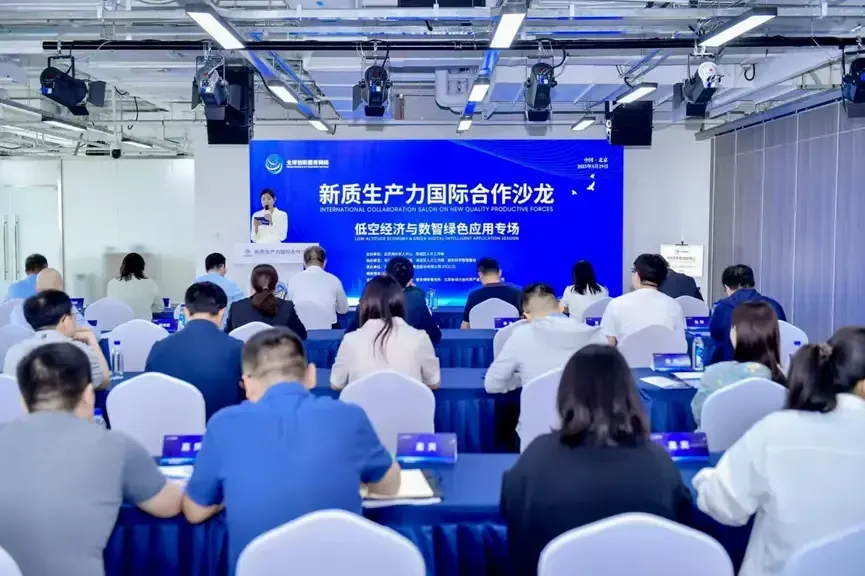
The First GNIS 2025 International Cooperation Salon on New Quality Productive Forces Successfully Held
Low-Altitude Economy and Intelligent Green Application in Focus
On May 29, 2025, the first GNIS 2025 International Cooperation Salon on New Quality Productive Forces—Low-Altitude Economy and Intelligent Green Application Session was successfully held at Beijing Xindongli Financial Street Science and Technology Center. The event was jointly organized by the Beijing Overseas Talents Center and the Xicheng District Talent Work Bureau, co-organized by the Fengtai District Talent Work Bureau, Haidian District Talent Work Bureau, and Xiong'an Science Park Administrative Committee, and hosted by Beijing International Human Resources Co., Ltd. (FESCO). The event was strongly supported by Inyoung Innovation International Think Tank, LongAn Law Firm, and Beijing Xindongli Jinke Asset Operation Management Co., Ltd., with exclusive media coverage by Yicai.
With the theme “Winged Future, Intelligent Integration: Global Dialogue on Beijing’s Low-Altitude Economy,” the salon brought together nearly 60 representatives from universities, research institutes, and technology companies in Beijing and Xiong'an, focusing on cutting-edge topics in the low-altitude economy and intelligent green applications, fostering cross-sector exchanges and resource sharing.
Authoritative Keynotes: Exploring New Opportunities in the Low-Altitude Economy
During the keynote session, Professor Shen Yingchun from Beihang University gave a comprehensive overview of the connotation, characteristics, current development, and industrial chain structure of the low-altitude economy, offering in-depth analysis of the opportunities and challenges faced by the industry. Cheng Bolin, Vice President of the Low-Altitude Economy Branch of the China Information Association, systematically reviewed the development trends, industrial features, and future prospects of the medium and large UAV industry, pointing out that China is moving from the “wheels era” to the “space economy era.” Professor Liu Yiliu from the Department of Mechanical and Industrial Engineering, Norwegian University of Science and Technology, shared online insights on the use and safety management of civilian drones in the Nordic region, providing inspiration for the integration of international experience.
In-Depth Roundtable: Regional Coordination and Innovative Breakthroughs
In the roundtable discussion, six experts from the China Academy of Information and Communications Technology (CAICT), Beihang University, Zhongguancun Science Park Fengtai Park, Times New Wave Information Technology Co., Ltd., Beijing-Tianjin-Hebei National Center for Technology Innovation Xiong'an Center, and LongAn Law Firm engaged in in-depth exchanges on topics such as “Differentiated Development of Low-Altitude Economy in Beijing's Districts,” “Beijing-Tianjin-Hebei Coordinated Development of the Low-Altitude Economy,” and “Low-Altitude and Trusted Data Space Construction, Air-Ground Coordination.” Panelists shared insights on leveraging regional advantages, promoting factor mobility, and breaking through development bottlenecks.
Chen Chuanzhi, Head of Low-Altitude Intelligent Business at CAICT, pointed out that fragmented airspace resources are a bottleneck that needs to be addressed. Professor Fan Dongming from Beihang University emphasized the challenge of cross-enterprise data sharing in low-altitude data circulation. Jiao Xinkang, Deputy Director of Zhongguancun Science Park Fengtai Park, introduced Fengtai District’s industrial layout and policy support for the low-altitude economy, highlighting a focus on building a low-altitude service ecosystem and providing free office space to support leading enterprises. Meng Youtong, Assistant General Manager and Head of Innovation Incubation at Beijing-Tianjin-Hebei National Center for Technology Innovation Xiong'an Center, elaborated on the ten advantages of developing the low-altitude economy in Xiong'an New Area. Panelists also discussed how to break down coordination and data barriers in the Beijing-Tianjin-Hebei low-altitude economy and promote the co-construction and sharing of enterprise information networks.
Building a Global Exchange Platform to Empower Young Talent Innovation
The International Cooperation Salon on New Quality Productive Forces is based on the “Link Beijing · Global Innovation Service Network (GNIS)” and is committed to creating a high-end think-tank academic exchange platform for young talents worldwide. It aims to help young people grasp the direction of breakthroughs in the new round of scientific and industrial revolutions, and contribute wisdom and strength to promoting high-quality development of productive forces. In the future, GNIS salons will continue to promote international innovation cooperation and talent exchange, empowering regional economies and industrial innovation and upgrading.
---